Current issue
Online first
Archive
About the Journal
Aims and scope
Publisher and Editorial
Advertising policy
Repository policy
Contact
Copyright
For Authors
Paper review procedures
Procedures protecting authentic authorship of papers
Paper preparation manual
Plagiarism check
Publication ethics
Reviewers
APC
Open Access Policy
Editorial and Scientific Board
Contact
Reviewers

Analysis of uncertainty a vehicle collision calculation methods

1
Department of Transport Engineering, Faculty of Mechanical and Energy Engineering, Koszalin University of Technology, Poland
2
brak afiliacji - absolwent WMiE Politechniki Koszalińskiej, Poland
Submission date: 2026-02-24
Final revision date: 2026-04-19
Acceptance date: 2026-04-27
Online publication date: 2026-06-19
Publication date: 2026-10-06
Corresponding author
Piotr Krzemień
Wydział Inżynierii Mechanicznej i Energetyki Katedra Inżynierii Transportu, Politechnika Koszalińska, Racławicka 15-19, 75-950, Koszalin, Poland
Wydział Inżynierii Mechanicznej i Energetyki Katedra Inżynierii Transportu, Politechnika Koszalińska, Racławicka 15-19, 75-950, Koszalin, Poland
Combustion Engines 2026,207(4), 85-92
KEYWORDS
vehicle collisionreconstruction calculationssimulation-based calculationscomputational uncertaintyenergy equivalent speed (EES)
TOPICS
ABSTRACT
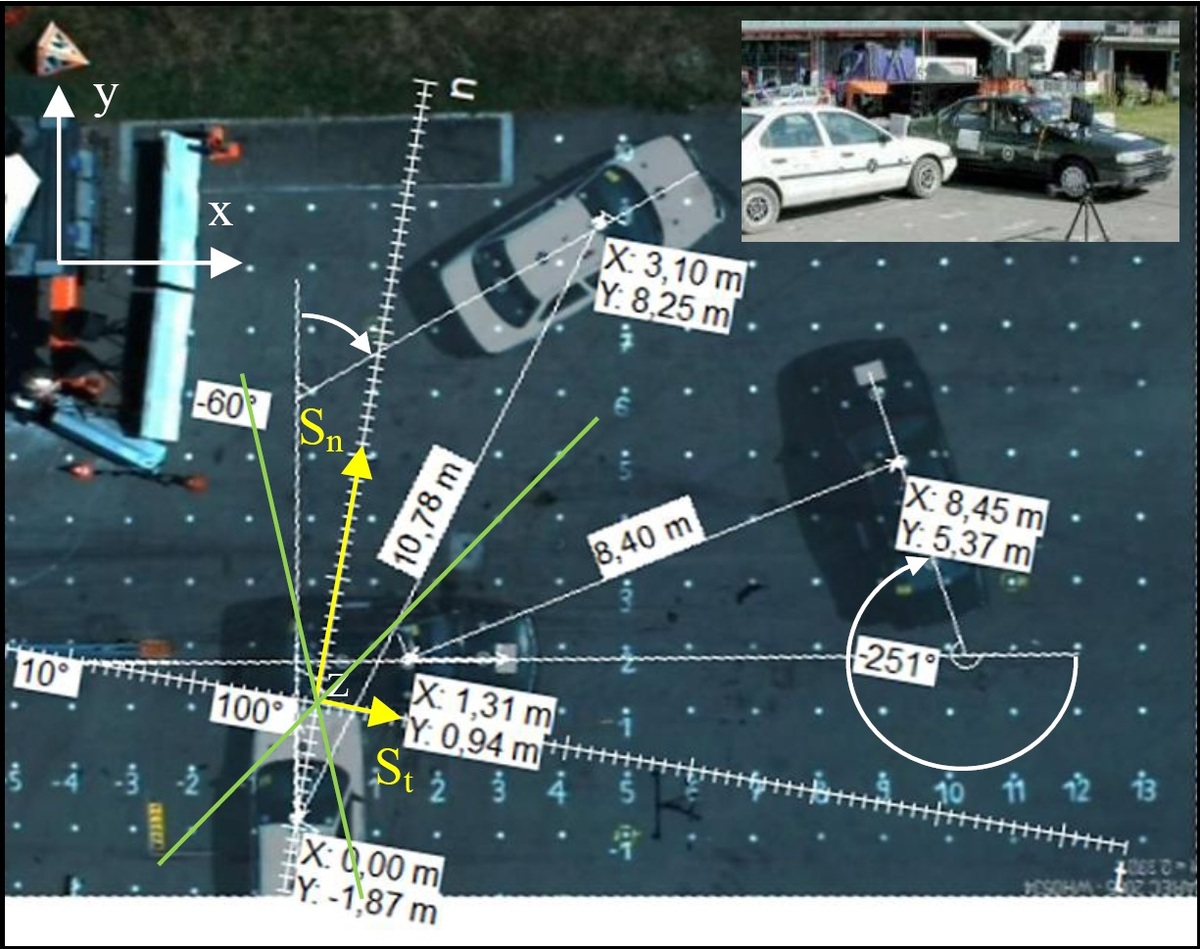
This article presents an uncertainty analysis of several of the most commonly used methods for calculating motor vehicle collision speeds. Based on a real-world crash test, a simulation-based collision model and an energy-based post-impact vehicle motion were developed in MATLAB. The calculation results were optimized using the Monte Carlo method. A custom-designed script was employed to search the full range of feasible solutions, and the results were compared with those obtained from analytical reconstruction methods and simulations conducted in two commercially available vehicle dynamics software packages. The study demonstrated that analytical calculations are highly sensitive to uncertainties in estimating the base post-impact trajectory angles and, depending on the reconstruction type (I, II, III, IV), to pre-impact approach angles. This sensitivity is not observed in simulation-based calculations, regardless of whether the post-impact motion is modeled using energy methods or vehicle dynamics models integrated into accident reconstruction software. Additionally, the performance of optimization algorithms built into these programs was analyzed. In this test, the uncertainties for the different methods – at measured speeds of 42.1 and 30.0 km/h – did not exceed ±13%. In contrast, randomizing the friction coefficient (µ) resulted in uncertainties of up to ±28% and varied across individual vehicles. These values are consistent with the theoretical analyses conducted by other researchers.
REFERENCES (20)
1.
Bułka D, Świder P. Model pojazdu zastosowany w programie V-SIM do symulacji ruchu i zderzeń pojazdów samochodowych (in Polish). Zeszyty Naukowe Politechniki Świętokrzyskiej. 2004;79:149-156.
2.
Cao Y, Luo Y. The synthesized method based on classical mechanics and finite element for vehicle collision accident reconstruction analysis. Int J Crashworthiness. 2022;27(6):1790-1797. https://doi.org/10.1080/135882....
3.
Guzek M, Lozia Z. Computing methods in the analysis of road accident reconstruction uncertainty. Arch Comput Methods Eng. 2021;28:2459-2476. https://doi.org/10.1007/s11831....
4.
Haller A. Estimation of the EES parameter value – a case study of the Toyota Yaris Hybrid. Combustion Engines. 2026;204(1):24-31. https://doi.org/10.19206/CE-21....
5.
Macurová L, Kohút P, Čopiak M, Imrich L, Rédl M. Determinig the energy equivalent speed by using software based on the Finite Element Method. Transportation Research Procedia. 2020;44:219-225. https://doi.org/10.1016/j.trpr....
6.
Ishikawa H. Impact center and restitution coefficients for accident reconstruction. SAE Technical Paper 940564. 1994. https://doi.org/10.4271/940564.
7.
Krzemień P, Gajek A. Wpływ współczynnika restytucji i kąta stożka tarcia na wyliczaną prędkość w zderzeniach – algorytm ewolucyjny jako narzędzie obliczeń (in Polish). Paragraf na Drodze. 2011;10.
8.
Krzemień P. Wpływ współczynników restytucji i tarcia w węźle zderzenia na prędkości przedzderzeniowe pojazdów. Algorytm optymalizacyjny jako narzędzie obliczeń (in Polish). Paragraf na drodze. 2011;4.
9.
Krzemień P. Optymalizacja modelu zderzenia pojazdów metodą ewolucyjną (in Polish). Doctoral Thesis. Cracov University of Technology, Cracov 2017.
10.
Moser A. Optimierungs – und Automatisierungsverfahren in der kinetischen Simulation von Straßenverkehrsunfällen, Dissertationsschrift, Institut für Mechanik, University of Graz. Graz 1998.
11.
Moser A, Steffan H. Automatic optimization of pre-impact parameters using post impact trajectories and rest positions. SAE Technical Paper 980373. 1998. https://doi.org/10.4271/980373.
12.
Pawelec KJ, Krzemień P. (ed.). Opiniowanie w sprawach przestępstw i wykroczeń drogowych (in Polish). Wolters Kluwer 2023.
13.
Prochowski L, Unarski J, Wach W, Wicher W. Podstawy rekonstrukcji wypadków drogowych (in Polish). Wydawnictwa Komunikacji i Łączności. Warsaw 2008.
14.
Reza A, Wierciński J. (ed.). Wypadki drogowe. Vademecum biegłego sądowego (in Polish). Instytut Ekspertyz Sądowych im. Prof. dra Jana Sehna w Krakowie. Kraków 2011.
15.
Świder P, Polański A, Grzegożek W. Analiza możliwości zastosowania metody rozwijania siły zderzenia dla celów rekonstrukcji wypadków drogowych (in Polish). Paragraf na Drodze. 2003;7.
16.
Unarski J, Zębala J. Zbiór podstawowych wzorów i równań stosowanych w analizie wypadków drogowych (in Polish). Wydawnictwo Instytut Ekspertyz Sądowych. Kraków 2012.
17.
Wach W. Wiarygodność strukturalna rekonstrukcji wypadków drogowych (in Polish). Instytut Ekspertyz Sądowych im. Prof. dra Jana Sehna w Krakowie. Kraków 2014.
18.
Zębala J, Kwieciński K. Deformation energy of a car: technical analysis and estimation ‘from experience’. Probl Forensic Sci. 2023;133:29-38. https://doi.org/10.4467/123074....
19.
Żuchowski A. The use of energy methods at the calculation of vehicle impact velocity. The Archives of Automotive Engineering – Archiwum Motoryzacji. 2015;68(2):85-111.
| eISSN: | 2658-1442 |
| ISSN: | 2300-9896 |


The scientific journal is financed under the Agreement 185/WCN/2019/1 from the funds of the Minister of Science and Higher Education
© 2006-2026 Journal hosting platform by Bentus
We process personal data collected when visiting the website. The function of obtaining information about users and their behavior is carried out by voluntarily entered information in forms and saving cookies in end devices. Data, including cookies, are used to provide services, improve the user experience and to analyze the traffic in accordance with the Privacy policy. Data are also collected and processed by Google Analytics tool (more).
You can change cookies settings in your browser. Restricted use of cookies in the browser configuration may affect some functionalities of the website.
You can change cookies settings in your browser. Restricted use of cookies in the browser configuration may affect some functionalities of the website.