Current issue
Online first
Archive
About the Journal
Aims and scope
Publisher and Editorial
Advertising policy
Repository policy
Contact
Copyright
For Authors
Paper review procedures
Procedures protecting authentic authorship of papers
Paper preparation manual
Plagiarism check
Publication ethics
Reviewers
APC
Open Access Policy
Editorial and Scientific Board
Contact
Reviewers

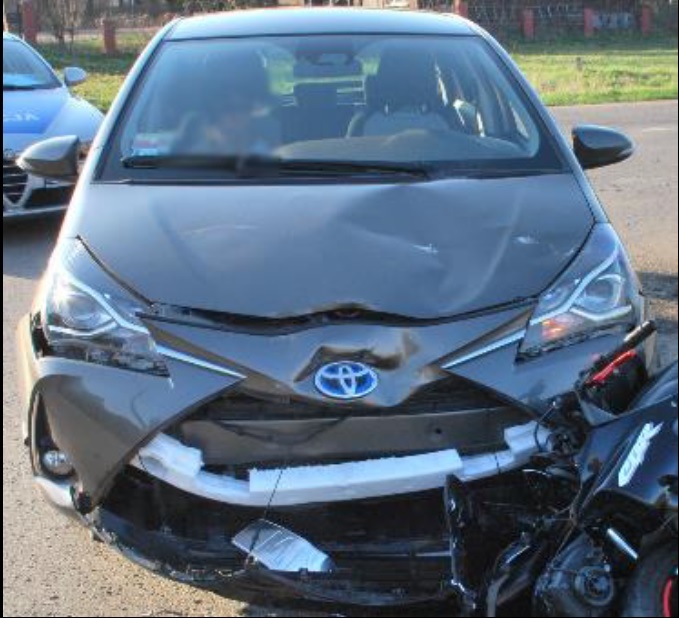
Estimation of the EES parameter value – a case study of the Toyota Yaris Hybrid
1
Mechanical Engineering Faculty, Doctoral School of Wroclaw University of Science and Technology, Poland
Submission date: 2025-08-27
Final revision date: 2026-02-21
Acceptance date: 2026-03-12
Online publication date: 2026-04-15
Publication date: 2026-10-06
Corresponding author
Agata Haller
Mechanical Engineering Faculty, Doctoral School of Wroclaw University of Science and Technology, Poland
Mechanical Engineering Faculty, Doctoral School of Wroclaw University of Science and Technology, Poland
Combustion Engines 2026,207(4), 43-48
KEYWORDS
TOPICS
ABSTRACT
Motor vehicles undergo plastic deformation as a result of colliding with each other or with another obstacle, which leads to a loss of the system's kinetic energy. The work of permanent deformation of a vehicle involved in a collision is equal to the loss of kinetic energy and is often represented as the value EES, i.e., Energy Equivalent Speed. This article describes three well-known and commonly used methods for estimating the value of deformation work: comparative, analytical, and graphical methods. The later section presents the calculation of the EES parameter using a comparative approach for a hybrid passenger vehicle struck by a motorcycle. Possible differences in estimating the value of the EES parameter have been indicated using this method for standard and hybrid vehicles.
REFERENCES (29)
1.
Bilík M, Bucsuházy K, Kostíková M, Mikulec R, Moravcová P. Z badań nad zależnością między energią zderzenia a deformacją pojazdu (in Polish). Paragraf na drodze. 2019;2:45-61.
2.
Burdzik R, Folęga P, Konieczny Ł, Łazarz B, Stanik Z, Warczek J. Analysis of material deformation work measures in determination of a vehicle's collision speed. Arch Mater Sci Eng. 2012;58(1):13-21. http://www.amse.acmsse.h2.pl/v....
3.
Campbell K. Energy basis for collision severity. SAE Technical Paper 740565. 1974. https://doi.org/10.4271/740565.
4.
Coufal T. Szacowanie wartości parametru EES dla pojazdu o nieznanych parametrach sztywności (in Polish). Paragraf na drodze. 2018:51-59.
5.
Datentechnik S. PC-Crash. A simulation program for vehicle accidents. Manual. Version 10.0. 2013.
7.
Droździel P, Pasaulis T, Pečeliūnas R, Pukalskas S. Evaluation of the energy equivalent speed of car damage using a finite element model. Vehicles. 2024;6(2):632-650. https://doi.org/10.3390/vehicl....
11.
Franck H, Franck D. Mathematical methods for accident reconstruction. Boca Raton: CRC Press, Taylor & Francis Group. 2009. https://doi.org/10.14669/AM.VO....
12.
Guzek M, Sztwiertnia K. Niepewność w określeniu prędkości EES zderzenia samochodów wyznaczanej metodą eksperymentalno-analityczną (in Polish). Archiwum Motoryzacji. 2017. https://doi.org/10.14669/AM.VO....
13.
Harmati IÁ, Varlaki P. Identification of energy distribution for crash deformational processes of road vehicles. Acta Polytechnica Hungarica. 2007.
15.
Kociemba D. Deformacja pojazdów przy zderzeniu czołowym – analiza porównawcza wyników testów zderzeniowych modeli wyprodukowanych w latach 1993–1997 oraz 2011–2015 (in Polish). Zarządzanie Innowacyjne w Gospodarce i Biznesie. 2021:147-162. https://doi.org/10.25312/2391-....
16.
Macurová L, Kohút P, Čopiak M, Imrich L, Rédl M. Determinig the energy equivalent speed by using software based on the finite element method. Transp Res Proc. 2020;44:219-225. https://doi.org/10.1016/j.trpr....
17.
Moravcová P, Bucsuházy K, Bilík M, Belak M, Bradáč A. Let it crash! Energy equivalent speed determination. 7th International Conference on Vehicle Technology and Intelligent Transport Systems; 2021;521-528. https://doi.org/10.5220/001044....
18.
Moravcová P, Bucsuházy K, Zůval R, Semela M, Bradáč A. What should I use to calculate vehicle EES? https://journals.plos.org/plos... (accessed on 2024 June 29).
20.
Owsiański R. Obliczanie EES dla zderzeń samochodów z dużymi prędkościami na podstawie danych z testów i parametrów odczytanych z EDR (in Polish). Paragraf na drodze. 2021;1:55-66.
21.
Polish Police, Police statistics. https://statystyka.policja.pl/... (accessed on 2024 November 14).
23.
Sierański K, Sitarek P, Jezierski K. Fizyka. Repetytorium. Wzory i prawa z objaśnieniami (in Polish). I ed. Scripta Wrocław 2002.
24.
Unarski J, Zębala J. Zbiór podstawowych wzorów i równań stosowanych w analizie wypadków drogowych (in Polish). 2nd ed. Instytut Ekspertyz Drogowych. Kraków 2012.
25.
Vangi D. Simplified method for evaluating energy loss in vehicle collisions. Accid Anal Prev. 2009:41(3):633-641. https://doi.org/10.1016/j.aap.....
26.
Wach W. Monte Carlo method in analysis of road accidents versus interpretation of calculation results. Archiwum Motoryzacji. 2014;4(66):193-215.
27.
Wierciński J, Reza A (eds). Wypadki drogowe. Vademecum biegłego sądowego (in Polish). II ed. Instytut Ekspertyz Sądowych. Kraków 2011.
28.
Zębala J., Kwieciński K. Deformation energy of a car: technical analysis and estimation ‘from experience’. Probl Forensic Sci. 2023;133:29-38. https://doi.org/10.4467/123074....
29.
Zębala J., Kwieciński K. Oszacowanie wartości EES samochodu osobowego przy wykorzystaniu metody elementów skończonych (in Polish). Paragraf na drodze. 2021;1:67-75.
CITATIONS (1):
1.
Analysis of uncertainty a vehicle collision calculation methods
Piotr Krzemień, Marcin Okuniewski, Dawid Murzyński, Piotr Piątkowski
Combustion Engines
Piotr Krzemień, Marcin Okuniewski, Dawid Murzyński, Piotr Piątkowski
Combustion Engines
| eISSN: | 2658-1442 |
| ISSN: | 2300-9896 |


The scientific journal is financed under the Agreement 185/WCN/2019/1 from the funds of the Minister of Science and Higher Education
© 2006-2026 Journal hosting platform by Bentus
We process personal data collected when visiting the website. The function of obtaining information about users and their behavior is carried out by voluntarily entered information in forms and saving cookies in end devices. Data, including cookies, are used to provide services, improve the user experience and to analyze the traffic in accordance with the Privacy policy. Data are also collected and processed by Google Analytics tool (more).
You can change cookies settings in your browser. Restricted use of cookies in the browser configuration may affect some functionalities of the website.
You can change cookies settings in your browser. Restricted use of cookies in the browser configuration may affect some functionalities of the website.