Current issue
Online first
Archive
About the Journal
Aims and scope
Publisher and Editorial
Advertising policy
Repository policy
Contact
Copyright
For Authors
Paper review procedures
Procedures protecting authentic authorship of papers
Paper preparation manual
Plagiarism check
Publication ethics
Reviewers
APC
Open Access Policy
Editorial and Scientific Board
Contact
Reviewers

Comparison of nitrogen oxide emission with two PEMS measurement methods
1
Automotive Development Institute in Bielsko-Biała, BOSMAL, Poland
2
Faculty of Civil and Transport Engineering, Poznan University of Technology
These authors had equal contribution to this work
Submission date: 2025-06-20
Final revision date: 2025-08-20
Acceptance date: 2025-08-27
Online publication date: 2025-10-07
Publication date: 2026-01-14
Corresponding author
Combustion Engines 2026,204(1), 88-95
KEYWORDS
TOPICS
ABSTRACT
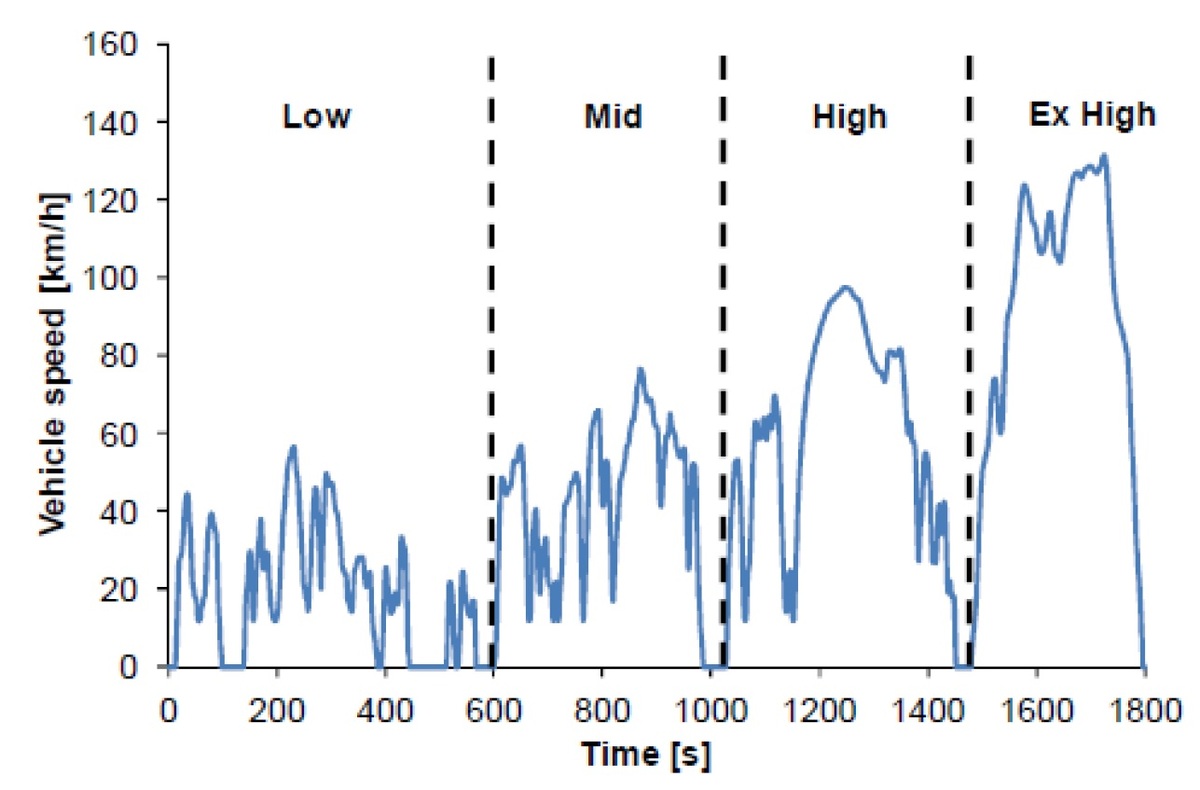
Mobile emission measurement systems (PEMS), according to current legal acts, can measure nitrogen oxide emission intensity using two different methods, one of which uses the chemiluminescence method and the other the ultraviolet light method. Stationary (laboratory) systems, according to the regulation, use only the chemiluminescence method. The following article analyses the results of tests obtained during WLTC tests from laboratory analysers (chemiluminescence method) with the results from two mobile analysers using nitrogen oxide analysers operating on the basis of two different methods. As a result of this analysis, the differences in the results of nitrogen oxide emissions from mobile systems compared to measurements from stationary systems in the WLTC test on a chassis dynamometer were described. The research was performed at the BOSMAL Institute of Automotive Research and Development using a passenger car equipped with a spark-ignition engine. The analysis showed differences in the results of nitrogen oxide emissions between mobile analysers for measuring nitrogen oxide emission intensity using the NDUV method and mobile analysers CLD. Measurements with mobile analysers also differ noticeably from the results obtained from stationary (laboratory) analysers. However, the greatest influence on the difference in the obtained results is the applied measurement method.
REFERENCES (19)
1.
Adamiak B, Andrych-Zalewska M, Merkisz J, Chłopek Z. The uniqueness of pollutant emission and fuel consumption test results for road vehicles tested on a chassis dynamometer. Eksploat Niezawodn. 2024;27(1). https://doi.org/10.17531/ein/1....
2.
Adamiak B, Szczotka A, Woodburn J, Merkisz J. Comparison of exhaust emission results obtained from Portable Emissions Measurement System (PEMS) and a laboratory system. Combustion Engines. 2023;195(4):128-135. https://doi.org/10.19206/CE-17....
5.
Bielaczyc P, Szczotka A, Klimkiewicz D. Wpływ analizatorów spalin na wyniki emisji oraz analiza możliwości zwiększenia dokładności pomiarów emisji gazo-wych związków szkodliwych spalin przez zastosowanie nowoczesnych analizatorów pod kątem badania, samochodów o bardzo niskiej emisji (in Polish). TTS Technika Transportu Szynowego. 2015.
6.
Commission Regulation (EU) 2017/1151 of 1 June 2017 supplementing Regulation (EC) No 715/2007 of the European Parliament and of the Council on type-approval of motor vehicles with respect to emissions from light passenger and commercial vehicles (Euro 5 and Euro 6) and on access to vehicle repair and maintenance information, amending Directive 2007/46/EC of the European Parliament and of the Council, Commission Regulation (EC) No 692/2008 and Commission Regulation (EU) No 1230/2012 and repealing Commission Regulation (EC) No 692/2008. Official Journal of the European Union, L 175, 1-643, 7.7.2017. https://eur-lex.europa.eu/eli/....
7.
Commission Regulation (EU) 2023/443 of 8 February 2023 amending Regulation (EU) 2017/1151 as regards the emission type approval procedures for light passenger and commercial vehicles (Text with EEA relevance). http://data.europa.eu/eli/ reg/2023/443/oj.
8.
Commission Regulation (EC) No 692/2008 of 18 July 2008 implementing and amending Regulation (EC) No 715/2007 of the European Parliament and of the Council on type approval of motor vehicles with respect to emissions from light passenger and commercial vehicles (Euro 5 and Euro 6) and on access to vehicle repair and maintenance information. Official Journal of the European Union, L199, 1136, 28.7.2008.
9.
European Commission. Joint Research Centre. Real Driving Emissions (RDE): 2020 assessment of Portable Emissions Measurement Systems (PEMS) measurement uncertainty. LU: Publications Office. 2021. https://data.europa.eu/doi/10.....
10.
Giechaskiel B, Lahde T, Suarez-Bertoa R, Clairotte M, Grigoratos T, Zardini A et al. Particle number measurements in the European legislation and future JRC activities. Combustion Engines. 2018;174(3):3-16. https://doi.org/10.19206/CE-20....
11.
Global technical regulation No. 15, Global technical regulation on Worldwide harmonized Light vehicles Test Procedures (WLTP), Amendment 3, Established in the Global Registry on 15 November 2017.
12.
Kasab JJ, Strzelec A. Automotive emissions regulations and exhaust aftertreatment systems. R-477. SAE International 2020.
13.
Klingenberg H. Automobile exhaust emission testing – measurement of regulated and unregulated exhaust gas components, exhaust emission tests. Springer-Verlag, Berlin-Heidelberg 1996. https://doi.org/10.1007/978-3-....
17.
Regulation No 101 of the Economic Commission for Europe of the United Nations (UN/ECE) – Uniform provisions concerning the approval of passenger cars powered by an internal combustion engine only, or powered by a hybrid electric power train with regard to the measurement of the emission of carbon dioxide and fuel consumption and/or the measurement of electric energy consumption and electric range, and of categories M1and N1vehicles powered by an electric power train only with regard to the measurement of electric energy consumption and electric range. Supplement 7 to the original version of the Regulation – Date of entry into force: 18 June 2007. https://eur-lex.europa.eu/eli/....
18.
Regulation No 115 of the Economic Commission for Europe of the United Nations (UN/ECE) Uniform provisions concerning the approval of: I. specific LPG (liquefied petroleum gases) retrofit systems to be installed in motor vehicles for the use of LPG in their propulsion system; II. specific CNG (compressed natural gas) retrofit systems to be installed in motor vehicles for the use of CNG in their propulsion system, Supplement 6 to the original version of the Regulation. https://eur-lex.europa.eu/eli/....
19.
Valverde V, Kondo Y, Otsuki Y, Krenz T, Melas A, Suarez-Bertoa R et al. Measurement of gaseous exhaust emissions of light-duty vehicles in preparation for Euro 7: a comparison of portable and laboratory instrumentation. Energies. 2023;16:2561. https://doi.org/10.3390/en1606....
Share
RELATED ARTICLE
| eISSN: | 2658-1442 |
| ISSN: | 2300-9896 |


The scientific journal is financed under the Agreement 185/WCN/2019/1 from the funds of the Minister of Science and Higher Education
© 2006-2026 Journal hosting platform by Bentus
We process personal data collected when visiting the website. The function of obtaining information about users and their behavior is carried out by voluntarily entered information in forms and saving cookies in end devices. Data, including cookies, are used to provide services, improve the user experience and to analyze the traffic in accordance with the Privacy policy. Data are also collected and processed by Google Analytics tool (more).
You can change cookies settings in your browser. Restricted use of cookies in the browser configuration may affect some functionalities of the website.
You can change cookies settings in your browser. Restricted use of cookies in the browser configuration may affect some functionalities of the website.