Current issue
Online first
Archive
About the Journal
Aims and scope
Publisher and Editorial
Advertising policy
Repository policy
Contact
Copyright
For Authors
Paper review procedures
Procedures protecting authentic authorship of papers
Paper preparation manual
Plagiarism check
Publication ethics
Reviewers
APC
Open Access Policy
Editorial and Scientific Board
Contact
Reviewers

Diagnostic analysis of exhaust gas with a rapidly changing temperature from a marine diesel engine: interaction analysis

1
Faculty of Mechanical Engineering and Ship Technology, Gdańsk University of Technology, Poland
Submission date: 2026-03-10
Final revision date: 2026-07-22
Acceptance date: 2026-08-28
Online publication date: 2026-09-17
Corresponding author
Patrycja Puzdrowska
Faculty of Mechanical Engineering and Ship Technology, Gdańsk University of Technology, Poland
Faculty of Mechanical Engineering and Ship Technology, Gdańsk University of Technology, Poland
KEYWORDS
marine diesel enginediagnostic informationfossil fuelsexhaust gas temperatureF-statistic of Fisher-Snedecor distribution
TOPICS
ABSTRACT
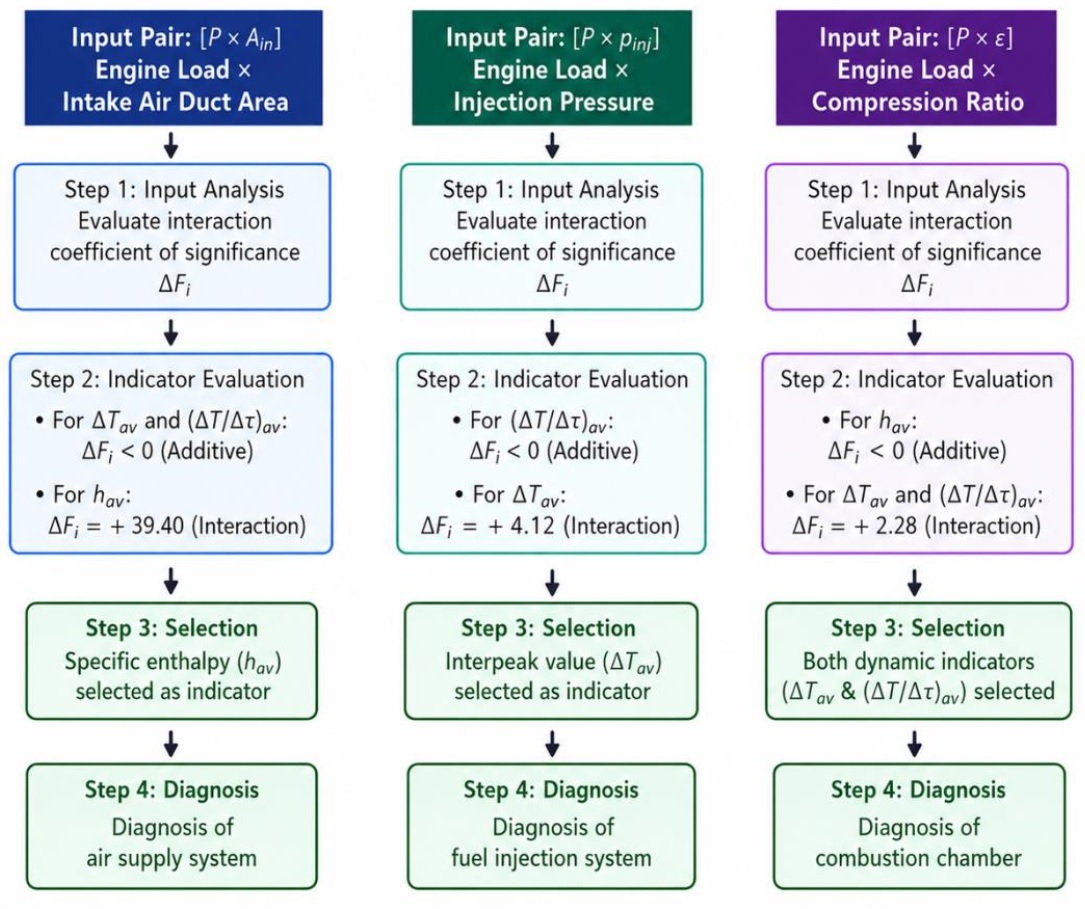
This article presents the next stage of research aimed at identifying the impact of input parameters, defined as changes in the design parameters of a marine diesel engine, on selected output parameters treated as diagnostic indicators derived from the rapidly varying exhaust gas temperature signal. In relation to earlier analyses of the individual and simultaneous impact of design parameters and engine load, the novelty of this study lies in assessing and quantifying the effects of interaction between these input factors using the interaction coefficient of significance. Three variable design parameters were analysed: active section area of the intake air duct Ain, injector opening pressure pinj, and compression ratio ε. Based on the rapidly varying exhaust gas temperature, three diagnostic indicators were defined for a single operating cycle of a four-stroke engine: hav, ΔTav and (ΔT/Δτ↑)av. The statistical analysis revealed that the strongest coupled interaction occurs between engine load P and intake air duct area Ain for the average specific enthalpy hav, reaching a positive interaction coefficient of ΔFi = +39.40. In contrast, dynamic indicators (ΔTav and (ΔT/Δτ↑)av) exhibited additive behavior for intake area changes (ΔFi = -1.124), but demonstrated significant positive interactions with injector pressure pinj (ΔFi = +4.12 for ΔTav) and compression ratio ε (ΔFi = +2.28 for both dynamic metrics). The results enabled formulation of conclusions and a criterion for selecting an appropriate diagnostic indicator depending on the analysed functional system of the diesel engine.
REFERENCES (23)
1.
Ajiban MH, Sudarmanta B. Synergistic effects of hydrogen enrichment and EGR on the performance and emissions of a diesel dual fuel engine: a statistical investigation. Combustion Engines. 2026. https://doi.org/10.19206/CE-22....
2.
Borovkov AA. Mathematical Statistics. Gordon and Breach Science Publishers. Amsterdam 1998.
3.
Debnath BK, Sahoo N, Saha UK. Thermodynamic analysis of variable compression ratio diesel engine running with palm oil methyl ester. Energy Convers Manag. 2013;65:147-154. https://doi.org/10.1016/j.enco....
4.
Heywood JB. Internal Combustion Engine Fundamentals. New York. McGraw-Hill Book Company. 1988.
6.
Klyus O, Rajewski P, Lebedevas S, Olszowski S. Determination of fuel atomization quality in compression ignition engines using acoustic emission signal. Combustion Engines. 2022;191(4):83-91. https://doi.org/10.19206/CE-14....
7.
Korczewski Z, Rudnicki J, Varbanets R, Minchev D. Multi-symptom diagnostic investigation of the working process of a marine diesel engine: case study part 1 measurement diagnostics. Pol Marit Res. 2025;32(2):50-61. https://doi.org/10.2478/pomr-2....
8.
Korczewski Z. Endoscopic diagnostics of marine engines. Diagnostyka. 2008;3(47):65-69. https://bibliotekanauki.pl/art....
9.
Korczewski Z. Test method for determining the chemical emissions of a marine diesel engine exhaust in operation. Pol Marit Res. 2021;28(3):76-87. https://doi.org/10.2478/pomr-2....
10.
Kuleshov A. Diesel-RK is an engine simulation tool. https://diesel-rk.com/Eng/ (accessed 1.07.2023).
11.
Li Y, Zhang S, Zhang W. Thermodynamic simulation-assisted random forest: towards explainable fault diagnosis of combustion chamber components of marine diesel engines. J Mar Sci Eng. 2025;251:117252. https://doi.org/10.1016/j.meas....
12.
Liang M, Chen M. Monitoring the performance of a ship’s main engine based on big data technology. Polsh Marit Res. 2022;29(3):128-140. https://doi.org/10.2478/pomr-2....
13.
Łomnicki A. Introduction to statistics for natural scientists., Scientific Publishing House PWN, Warsaw 2014.
14.
Minchev D, Varbanets R, Shumylo O, Zalozh V, Aleksandrovska N, Bratchenko P et al. Digital twin test-bench performance for marine diesel engine applications. Pol Marit Res. 2023;30(4):81-91. https://doi.org/10.2478/pomr-2....
15.
Monieta J. Selection of diagnostic symptoms and injection subsystems of marine reciprocating internal combustion engines. Appl Sci. 2019;9(8):1540. https://doi.org/10.3390/app908....
16.
Pham V. Research on the application of diesel-RK in the calculation and evaluation of technical and economic criteria of marine diesel engines using the unified ULSD and biodiesel blended fuel. J Mech Eng Res Dev. 2019, https://doi.org/10.26480/jmerd....
17.
Puzdrowska P. Diagnostic analysis of exhaust gas with a quick-changing temperature from a marine diesel engine part II two factor analysis. Pol Marit Res. 2023;30(3):89-95, https://doi.org/10.2478/pomr-2....
18.
Puzdrowska P. Diagnostic information analysis of quickly changing temperature of exhaust gas from marine diesel engine part I single factor analysis. Pol Marit Res. 2021;28(4):97-106. https://doi.org/10.2478/pomr-2....
19.
Puzdrowska P. Signal filtering method of the fast-varying diesel exhaust gas temperature. Combustion Engines. 2018;175(4):48-52. https://doi.org/10.19206/CE-20....
20.
Varbanets R, Shumylo O, Marchenko A, Minchev D, Kyrnats V et al. Concept of vibroacoustic diagnostics of the fuel injection and electronic cylinder lubrication systems of marine diesel engines. Pol Marit Res. 2022;29(4):88-96. https://doi.org/10.2478/pomr-2....
21.
Witkowski K. The increase of operational safety of ships by improving diagnostic methods for marine diesel engine. TransNav the International Journal on Marine Navigation and Safety of Sea Transportation. 2017;11(2):317-321. https://doi.org/10.12716/1001.....
22.
Zhou R, Cao J, Zhang G, Yang X, Wang X. Heat load forecasting of marine diesel engine based on long short-term memory network. Appl Sci. 2023;13(2):1099. https://doi.org/10.3390/app130....
23.
Zimakowska-Laskowska M, Bogdanowicz A, Kniaziewicz T. Assessment of exhaust gas concentration uniformity in a marine engine duct based on dual-point sampling and CFD modelling. Combustion Engines. 2026;205(2):3-16. https://doi.org/10.19206/CE-20....
Share
RELATED ARTICLE
| eISSN: | 2658-1442 |
| ISSN: | 2300-9896 |


The scientific journal is financed under the Agreement 185/WCN/2019/1 from the funds of the Minister of Science and Higher Education
© 2006-2026 Journal hosting platform by Bentus
We process personal data collected when visiting the website. The function of obtaining information about users and their behavior is carried out by voluntarily entered information in forms and saving cookies in end devices. Data, including cookies, are used to provide services, improve the user experience and to analyze the traffic in accordance with the Privacy policy. Data are also collected and processed by Google Analytics tool (more).
You can change cookies settings in your browser. Restricted use of cookies in the browser configuration may affect some functionalities of the website.
You can change cookies settings in your browser. Restricted use of cookies in the browser configuration may affect some functionalities of the website.