Current issue
Online first
Archive
About the Journal
Aims and scope
Publisher and Editorial
Advertising policy
Repository policy
Contact
Copyright
For Authors
Paper review procedures
Procedures protecting authentic authorship of papers
Paper preparation manual
Plagiarism check
Publication ethics
Reviewers
APC
Open Access Policy
Editorial and Scientific Board
Contact
Reviewers

Modeling of stochastic passenger car velocity processes for the purpose of pollutant emission inventory

1
Department for Emissions Inventory and Spatial Analysis, Emission Inventory Unit, National Centre for Emissions Management, Institute of Environmental Protection – National Research Institute, Poland
2
Research Group of Fuels and Bioeconomy, Łukasiewicz Research Network – Automotive Industry Institute, Poland
These authors had equal contribution to this work
Submission date: 2025-10-13
Final revision date: 2026-02-10
Acceptance date: 2026-02-14
Online publication date: 2026-03-03
Publication date: 2026-07-02
Corresponding author
Katarzyna Bebkiewicz
Department for Emissions Inventory and Spatial Analysis, Emission Inventory Unit, National Centre for Emissions Management, Institute of Environmental Protection – National Research Institute, Słowicza 32, 02-170, Warsaw, Poland
Department for Emissions Inventory and Spatial Analysis, Emission Inventory Unit, National Centre for Emissions Management, Institute of Environmental Protection – National Research Institute, Słowicza 32, 02-170, Warsaw, Poland
Combustion Engines 2026,206(3), 151-158
KEYWORDS
TOPICS
ABSTRACT
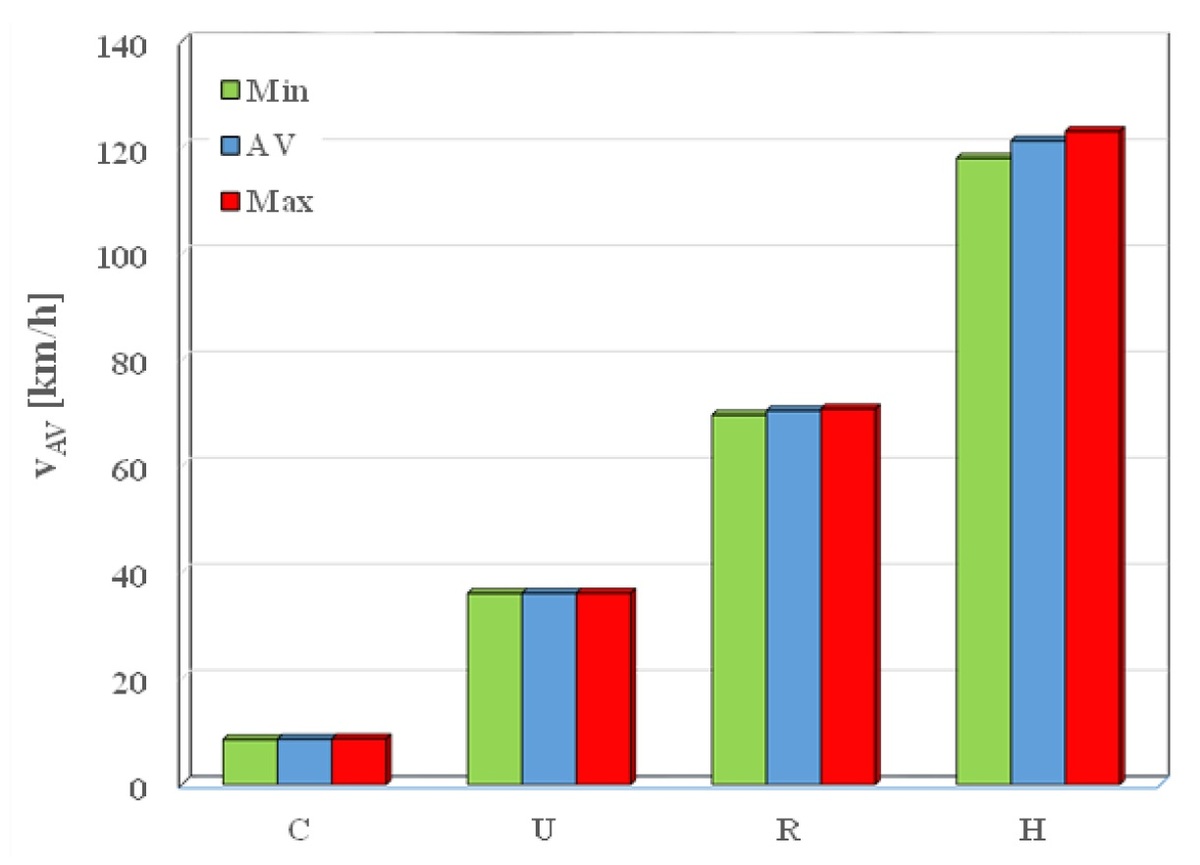
This paper discusses the potential use of stochastic processes as road vehicle velocity models for road transport emissions inventory purposes. Empirical studies have presented stochastic passenger-car velocity models, each modeling traffic conditions: in traffic congestion, in cities outside traffic congestion, outside cities, and on highways and expressways. Zero-dimensional characteristics of the model velocity processes have been examined. The characteristics of passenger car emissions for 2020 have been determined using simulation methods. Road pollutant emissions from passenger cars under specific velocity process implementations have been determined and analyzed. The research results have been assessed, among other things, for their variability. Based on the results, the feasibility of using stochastic processes as road vehicle velocity models for road transport emissions inventory purposes has been assessed.
REFERENCES (16)
1.
Andrych-Zalewska M. Research of pollutant emissions from automotive internal combustion engines in conditions corresponding to the actual use of vehicles. Combustion Engines. 2023;193(2):64-70. https://doi.org/10.19206/CE-16....
2.
Bendat JS, Piersol AG. Random data: analysis and measurement procedures. Book Series: Wiley Series in Probability and Statistics. https://doi.org/10.1002/978111....
3.
BUWAL (Bundesamt für Umwelt, Wald und Landschaft), INFRAS AG (Infrastruktur-, Umwelt- und Wirtschaftsberatung). Luftschadstoffemissionen des Strassenverkehrs 1950–2010, BUWAL-Bericht 1995;255.
4.
Chłopek Z, Biedrzycki J, Lasocki J, Wójcik P. Investigation of pollutant emissions from a motor vehicle engine in tests simulating real vehicle use in road traffic conditions. Combustion Engines. 2013;154(3):202-207.
8.
INFRAS AG. Handbook emission factors for road transport 3.2. Quick reference. Version 3.2. Bern, 2014.
10.
Otnes RK, Enochson L. Applied time series analysis: basic techniques. John Wiley & Sons, Inc. 1978.
11.
Papoulis A, Pillai SU. Probability, random variables, and stochastic processes. Tata McGraw-Hill, 2002; 852.
13.
Ralston A, Rabinowitz P. A first course in numerical analysis: Second Edition. Dover Publications Inc. 2001.
14.
Savitzky A, Golay MJE. Smoothing and differentiation of data by simplified least squares procedures. Analytical Chemistry. 1964;36(8):1627-1639. https://doi.org/10.1021/ac6021....
15.
Worldwide emission standards. Passenger cars and light duty vehicles. Delphi. Innovation for the real world. 2020/ 2021.
16.
Worldwide emissions standards. Heavy duty and off-highway vehicles. Delphi. Innovation for the real world. 2016/2017.
Share
RELATED ARTICLE
| eISSN: | 2658-1442 |
| ISSN: | 2300-9896 |


The scientific journal is financed under the Agreement 185/WCN/2019/1 from the funds of the Minister of Science and Higher Education
© 2006-2026 Journal hosting platform by Bentus
We process personal data collected when visiting the website. The function of obtaining information about users and their behavior is carried out by voluntarily entered information in forms and saving cookies in end devices. Data, including cookies, are used to provide services, improve the user experience and to analyze the traffic in accordance with the Privacy policy. Data are also collected and processed by Google Analytics tool (more).
You can change cookies settings in your browser. Restricted use of cookies in the browser configuration may affect some functionalities of the website.
You can change cookies settings in your browser. Restricted use of cookies in the browser configuration may affect some functionalities of the website.