Current issue
Online first
Archive
About the Journal
Aims and scope
Publisher and Editorial
Advertising policy
Repository policy
Contact
Copyright
For Authors
Paper review procedures
Procedures protecting authentic authorship of papers
Paper preparation manual
Plagiarism check
Publication ethics
Reviewers
APC
Open Access Policy
Editorial and Scientific Board
Contact
Reviewers

Seasonal environmental assessment of PEMFC/BOP components in a ship hybrid propulsion system under Baltic Sea and North Sea conditions

1
Faculty of Mechanical and Electrical Engineering, Polish Naval Academy, Poland
2
Faculty of Mechanical Engineerin, Wrocław University of Science and Technology, Poland
Submission date: 2026-05-05
Final revision date: 2026-07-23
Acceptance date: 2026-09-08
Online publication date: 2026-09-28
Corresponding author
KEYWORDS
TOPICS
ABSTRACT
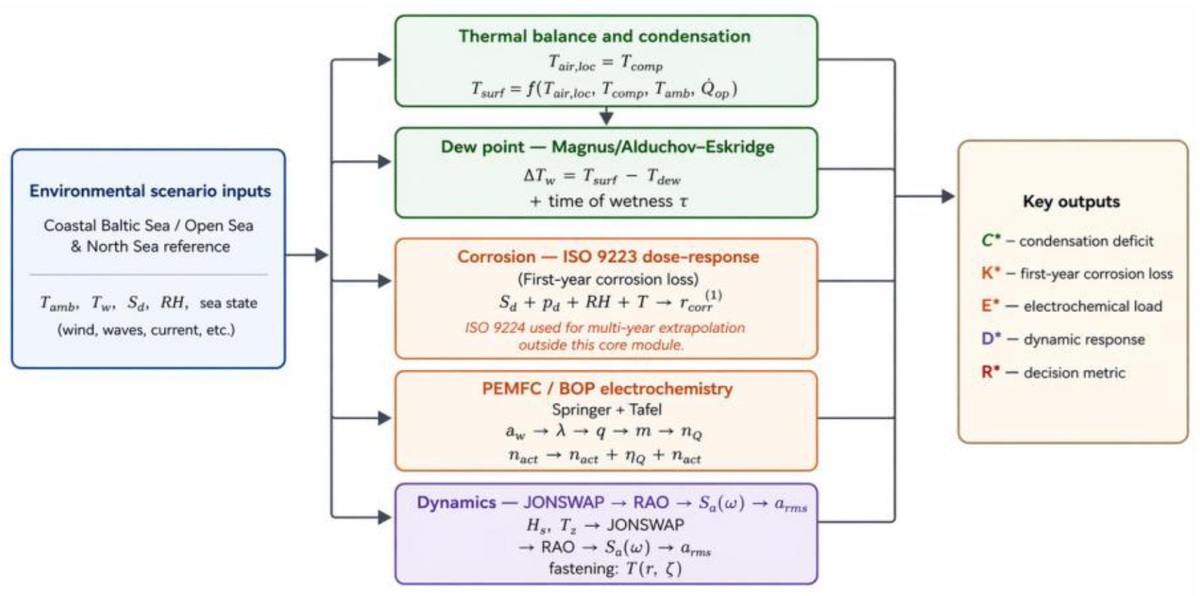
This paper presents an analysis of the impact of the marine environment on selected components of a ship hybrid propulsion system, including the PEMFC/BOP section (auxiliary equipment), structural elements and mountings. The analysis was carried out for Baltic Sea conditions, with four seasons, two exposure levels and North Sea reference scenarios with high chloride deposition. Four mutually complementary assessment areas were considered: thermal-moisture, corrosion, electrochemical and dynamic effects. The thermal-moisture part was described using a heat balance and the dew point. Corrosion effects were determined from chloride deposition S_d and the ISO 9223 dose-response function. The PEM electrochemical part was represented using the Springer relations and the Tafel equation, whereas the dynamic part was described using the JONSWAP spectrum, the RAO operator and the rms acceleration a_rms. The scenarios were compared using the proposed decision metric R*. The results indicate that the total environmental load results from the simultaneous influence of condensation, corrosion, electrochemical loading and dynamics, with individual mechanisms dominating under different operating conditions. In particular, two main sources of risk were separated: a humid-salt environment, which intensifies corrosion processes, and dry conditions, which reduce membrane hydration and increase the electrochemical load of the FC section. The study also shows that suitably selected protective measures and changes in system configuration can significantly reduce the overall environmental impact in terms of corrosion as well as dynamic and electrochemical loads. The proposed approach may be used as a preliminary environmental qualification tool and as a basis for planning further validation tests.
REFERENCES (45)
1.
Alduchov OA, Eskridge RE. Improved magnus form approximation of saturation vapor pressure. J Appl Meteorol. 1996;35(4):601-609. https://doi.org/10.1175/1520-0...<0601:IMFAOS>2.0.CO;2.
2.
Andrych-Zalewska M, Chłopek Z, Lasocki J, Merkisz J, Pielecha J. A stochastic approach to the analysis of pollutant emissions and fuel consumption of motor vehicles driven in real traffic. Appl Sci. 2024;14(23):11346. https://doi.org/10.3390/app142....
3.
Andrych-Zalewska M, Chłopek Z, Merkisz J, Pielecha J. Exhaust emission from a vehicle engine operating in dynamic states and conditions corresponding to real driving. Combustion Engines. 2019;178(3):99-105. https://doi.org/10.19206/CE-20....
4.
Bampaou M, Georgiou D, Papaioannou K, Panopoulos KD. Post-mortem analysis as a method to identify degradation of PEM fuel cells affecting their durability in maritime applications. Int J Hydrogen Energy. 2025;177:151574. https://doi.org/10.1016/j.ijhy....
5.
Barbir F. PEM fuel cells: theory and practice. 2nd ed. Academic Press; 2012. https://shop.elsevier.com/book....
6.
Bard AJ, Faulkner LR. Electrochemical methods: fundamentals and applications. 2nd ed. Wiley; 2001. https://search.worldcat.org/ti....
7.
Björkqvist J-V, Kanarik H, Tuomi L, Niskanen L, Kankainen M. Event-based wave statistics for the Baltic Sea. State of the Planet. 2024;4-osr8:10. https://doi.org/10.5194/sp-4-o....
8.
Broer A, Polinder H, van Biert L. Polymer electrolyte membrane fuel cell degradation in ships: review of degradation mechanisms and research gaps. J Power Sources. 2025;640:236678. https://doi.org/10.1016/j.jpow....
9.
Choi H, Choi H, Choi HJ, Kim J, Kim O-H, Kim Y et al. Polymer electrolyte membrane fuel cell durability test using ship operation profile: a comparative study with durability test protocols. J Power Sources. 2025;632:236396. https://doi.org/10.1016/j.jpow....
10.
Dall’Armi C, Pivetta D, Taccani R. Hybrid PEM fuel cell power plants fuelled by hydrogen for improving sustainability in shipping: state of the art and review on active projects. Energies. 2023;16(4):2022. https://doi.org/10.3390/en1604....
11.
Dudek M, Lis B, Raźniak A, Krauz M, Kawalec M. Selected aspects of designing modular PEMFC stacks as power sources for unmanned aerial vehicles. Appl Sci. 2021;11(2):675. https://doi.org/10.3390/app110....
12.
Dudek M, Raźniak A, Rosół M, Siwek T, Dudek P. Design, development, and performance of a 10 kW polymer exchange membrane fuel cell stack as part of a hybrid power source designed to supply a motor glider. Energies. 2020;13(17):4393. https://doi.org/10.3390/en1317....
13.
Dudek M, Zarzycki M, Raźniak A, Rosół M. Applying a 2 kW polymer membrane fuel-cell stack to building hybrid power sources for unmanned ground vehicles. Energies. 2023;16(22):7531. https://doi.org/10.3390/en1622....
14.
Filina-Dawidowicz L, Filin S, Wojnicz L, Miłek D, Grzelak P. Energy-efficient maritime transport of refrigerated containers. Procedia Comput Sci. 2022;207:3572-3581. https://doi.org/10.1016/j.proc....
15.
Finnish Meteorological Institute. Ice season in the Baltic Sea. Helsinki: FMI; accessed 18 Apr 2026. https://en.ilmatieteenlaitos.f....
16.
Hasselmann K, Barnett TP, Bouws E, Carlson H, Cartwright DE, Enke K et al. Measurements of wind-wave growth and swell decay during the Joint North Sea Wave Project (JONSWAP). Ergänzungsheft zur Deutschen Hydrographischen Zeitschrift, Reihe A(8) Nr. 12. Hamburg: Deutsches Hydrographisches Institut; 1973. https://repository.tudelft.nl/....
17.
HELCOM. About the Baltic Sea. State of the Baltic Sea 2023. Helsinki Commission; 2023. https://stateofthebalticsea.he....
18.
HELCOM. Wave climate in the Baltic Sea 2023 (BSEFS). Helsinki Commission; 2024. https://helcom.fi/publications....
20.
ISO 9223:2012. Corrosion of metals and alloys - Corrosivity of atmospheres – Classification, determination and estimation. Geneva: International Organization for Standardization; 2012. https://www.iso.org/standard/5....
21.
ISO 9224:2012. Corrosion of metals and alloys - Corrosivity of atmospheres – Guiding values for the corrosivity categories. Geneva: International Organization for Standardization; 2012. https://www.iso.org/standard/5....
22.
ISO 9225:2012. Corrosion of metals and alloys - Corrosivity of atmospheres – Measurement of environmental parameters affecting corrosivity of atmospheres. Geneva: International Organization for Standardization; 2012. https://www.iso.org/standard/5....
23.
Itämeri.fi. Water temperature – The Baltic Sea. Finnish Environment Institute/Finnish Meteorological Institute; accessed 18 Apr 2026. https://itameri.fi/en/the-balt....
24.
ITTC. Seakeeping Experiments. Recommended Procedures and Guidelines 7.5-02-07-02.1. 2024 Revision 08. International Towing Tank Conference; 2024. https://ittc.info/downloads/qu....
25.
Kozak M, Chmiel J. Cold ironing galvanic corrosion issues with regard to a shore-to-ship medium voltage connection. Energies. 2020;13(20):5372. https://doi.org.org/10.3390/en....
26.
Larminie J, Dicks A. Fuel Cell systems explained. 2nd ed. Wiley; 2003. https://doi.org/10.1002/978111....
27.
Leo TJ, Durango JA, Navarro E. Exergy analysis of PEM fuel cells for marine applications. Energy. 2010;35(2):1164-1171. https://doi.org/10.1016/j.ener....
28.
Li S, Zhu J, Yang G, Shen Q. A review on impact of the marine salt spray environment on the performance of proton exchange membrane fuel cells. J Mar Sci Eng. 2025;13(1):172. https://doi.org/10.3390/jmse13....
29.
Lim J, Koo J, Shim JH. Failure modes of polymer electrolyte membrane fuel cell membrane-electrode assemblies in air-independent applications. Case Stud Therm Eng. 2025;76:107455. https://doi.org/10.1016/j.csit....
30.
McCay K, Karstensen PEE, Gerhardt M, Coolegem J, Damiano D, Lædre S. An analysis of the reversible and irreversible degradation of a PEM fuel cell short-stack operated under simulated maritime conditions. J Power Sources. 2026;665:239011. https://doi.org/10.1016/j.jpow....
31.
NOAA NCEI. WMO Code Table 3700: Sea State. National Oceanographic Data Center; accessed 18 Apr 2026. https://www.ncei.noaa.gov/acce....
32.
O’Hayre R, Cha SW, Colella W, Prinz FB. Fuel Cell Fundamentals. 3rd ed. Wiley; 2016. https://doi.org/10.1002/978111....
33.
Radica G, Tolj I, Nyamsi SN, Vidović T. Performances of proton exchange membrane fuel cells in marine application. Int J Hydrogen Energy. 2025;142:186-194. https://doi.org/10.1016/j.ijhy....
34.
Rostrup-Nielsen JR, Rostrup-Nielsen T. Reforming hydrocarbons for fuel cells. Springer 2011. https://doi.org/10.1016/B978-0....
35.
Singheiser L, Huczkowski P, Markus T, Quadakkers WJ. High temperature corrosion issues for metallic materials in solid oxide fuel cells. In: Shreir’s Corrosion. Elsevier 2010:482-517. https://doi.org/10.1016/B978-0....
36.
Socik P. Analysis of the impact of the marine environment on components of the hybrid propulsion system of a project 207M vessel. Gdynia: Polish Naval Academy; 2024.
37.
Springer TE, Zawodzinski TA, Gottesfeld S. Polymer electrolyte fuel cell model. J Electrochem Soc. 1991;138(8):2334-2342. https://doi.org/10.1149/1.2085....
38.
Tamburello S, Cirillo MR, Yakovlev Y, Matolínová I, Taccani R, Coraddu A et al. Preliminary methodology assessment for PEMFC durability testing in transport applications. Electrochim Acta. 2026;554:148267. https://doi.org/10.1016/j.elec....
39.
Van Hoecke L, Laffineur L, Campe R, Perreault P, Verbruggen SW, Lenaerts S. Challenges in the use of hydrogen for maritime applications. Energy Environ Sci. 2021;14:815-843. https://doi.org/10.1039/D0EE01....
40.
Wen X, Zhu D, Hnydiuk-Stefan A, Ma Z, Królczyk G, Li Z. Energy storage performance of hydrogen fuel cells operating in a marine salt spray environment using experimental evaluation. Int J Hydrogen Energy. 2024;52:213-225. https://doi.org/10.1016/j.ijhy....
41.
Xing H, Stuart C, Spence S, Chen H. Fuel cell power systems for maritime applications: progress and perspectives. Sustainability. 2021;13(3):1213. https://doi.org/10.3390/su1303....
42.
Zacharewicz M, Bogdanowicz A, Socik P. Capacitance-based assessment of water content in fuels and lubricating oils for marine engines. Combustion Engines. 2025;202(3):81-87. https://doi.org/10.19206/CE-20....
43.
Zadrąg R, Socik P, Kniaziewicz T, Zacharewicz M, Bogdanowicz A, Wirkowski P. Analysis of simulated dynamic loads of a ship propulsion system of a non-conventional power system. Combustion Engines. 2024;197(2):158-168. https://doi.org/10.19206/CE-18....
44.
Zimakowska-Laskowska M, Kniaziewicz T. Analysis of methods for estimating pollutant emissions from marine engines in terms of their use for evaluating ambient air quality. Combustion Engines. 2025;202(3):3-10. https://doi.org/10.19206/CE-20....
45.
Zimakowska-Laskowska M, Kozłowski E, Wiśniowski P, Żbik K, Świderski A, Rostek E et al. The influence of ambient temperature on exhaust emissions during cold start in the homologation test. Combustion Engines. 2025;203(4):50-58. https://doi.org/10.19206/CE-20....
Share
RELATED ARTICLE
| eISSN: | 2658-1442 |
| ISSN: | 2300-9896 |


The scientific journal is financed under the Agreement 185/WCN/2019/1 from the funds of the Minister of Science and Higher Education
© 2006-2026 Journal hosting platform by Bentus
We process personal data collected when visiting the website. The function of obtaining information about users and their behavior is carried out by voluntarily entered information in forms and saving cookies in end devices. Data, including cookies, are used to provide services, improve the user experience and to analyze the traffic in accordance with the Privacy policy. Data are also collected and processed by Google Analytics tool (more).
You can change cookies settings in your browser. Restricted use of cookies in the browser configuration may affect some functionalities of the website.
You can change cookies settings in your browser. Restricted use of cookies in the browser configuration may affect some functionalities of the website.