Current issue
Online first
Archive
About the Journal
Aims and scope
Publisher and Editorial
Advertising policy
Repository policy
Contact
Copyright
For Authors
Paper review procedures
Procedures protecting authentic authorship of papers
Paper preparation manual
Plagiarism check
Publication ethics
Reviewers
APC
Open Access Policy
Editorial and Scientific Board
Contact
Reviewers

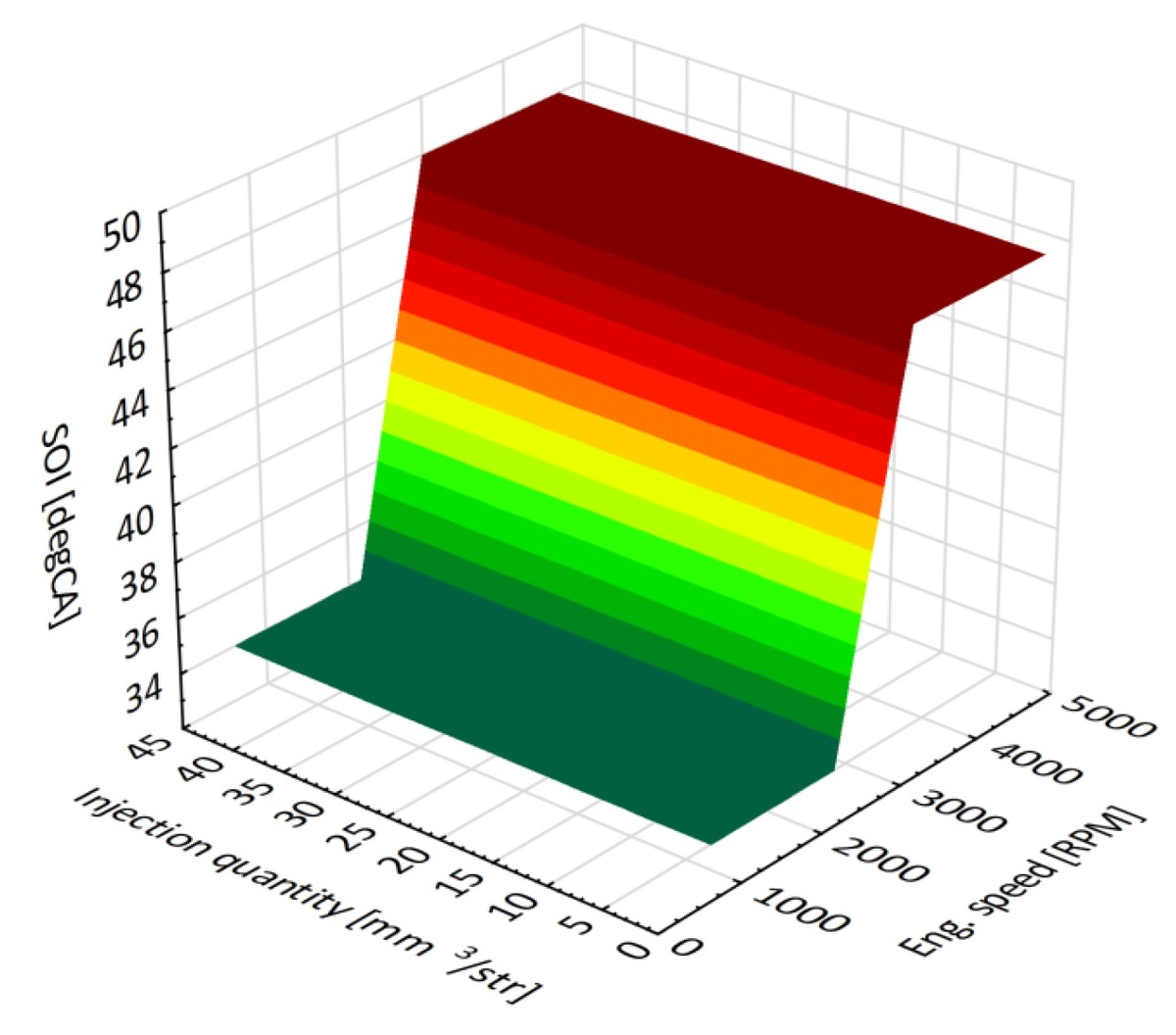
Selected parameters of the combustion process in a compression-ignition engine at different angles of the beginning of injection of mixtures of rapeseed oil with n-hexane

1
Department of Automotive Vehicles, Lublin University of Technology, Poland
Submission date: 2025-06-21
Final revision date: 2025-10-01
Acceptance date: 2025-10-01
Online publication date: 2025-12-10
Publication date: 2026-07-02
Corresponding author
Rafał Longwic
Department of Automotive Vehicles, Lublin University of Technology, Nadbystrzycka 36, 20-618, Lublin, Poland
Department of Automotive Vehicles, Lublin University of Technology, Nadbystrzycka 36, 20-618, Lublin, Poland
Combustion Engines 2026,206(3), 3-8
KEYWORDS
TOPICS
ABSTRACT
The article presents the results of experiments in which a compression-ignition engine was fueled with a mixture of rapeseed oil with a 10% addition of n-hexane. The effect of changing the fuel injection start angle on selected indicators of the combustion process was evaluated. The tests were conducted at a fixed vehicle speed of 90 km/h. The addition of n-hexane made it possible to improve the characteristics of the combustion process of rapeseed oil. The maximum combustion pressure increased to 9.5 MPa (ON: 9.66 MPa; OR: 8.71 MPa), and the ignition delay was shortened. Advancing the pilot injection by - 6° CA resulted in stabilization of the kinetic combustion phase; in reality, due to map interpolations and auto-adaptation strategies of the controller, the offset was approx. - 4° CA, indicating that it must be taken into account in the interpretation of the results. The average indexed pressure reached 0.805 MPa (ON: 0.813 MPa; OR: 0.728 MPa), and the maximum pressure build-up rate (dp/dα) reached 0.375 MPa/°CA, approaching the 0.399 MPa/°CA recorded for ON. The rate of heat release was in the range of 86-93 kJ/m³-°CA, clearly lower than that of OR (130 kJ/m³-°CA). The results confirm that appropriate modification of the fuel composition, together with a properly selected injection angle, allows compression-ignition engines to burn renewable fuels. The results of the measurements were described with regression relationships, which allows their use in further simulation and development work.
REFERENCES (17)
1.
Adamiak B, Andrych-Zalewska M, Merkisz J, Chłopek Z. The uniqueness of pollutant emission and fuel con- sumption test results for road vehicles tested on a chassis dynamometer. Eksploat Niezawodn. 2025;27(1). https://doi.org/10.17531/ein/1....
2.
Harari PA, Banapurmath NR, Yaliwal VS, Yunus Khan TM, Badruddin IA, Kamangar S et al. Effect of injection timing and injection duration of manifold injected fuels in reactivity-controlled compression ignition engine operated with renewable fuels. Energies. 2021;14(15):4621. https://doi.org/10.3390/en1415....
3.
Jaworski A, Kuszewski H, Longwic R, Sander P. Assessment of self-ignition properties of canola-oil/n-hexane blends in a constant-volume combustion chamber and compression-ignition engine. Appl Sci. 2023;13(19):10558. https://doi.org/10.3390/app131....
4.
Kozak M. Exhaust emissions from a diesel passenger car fuelled with a diesel fuel-butanol blend, SAE Technical Paper. 2011-28-0017. 2011. https://doi.org/10.4271/2011-2....
5.
Kozak M, Lijewski P, Waligórski M. Exhaust emissions from a hybrid city bus fuelled by conventional and oxygenated fuel. Energies. 2022;15:1123. https://doi.org/10.3390/en1503....
6.
Kozak M, Merkisz J. Oxygenated diesel fuels and their effect on PM emissions. Appl Sci. 2022;12:7709. https://doi.org/10.3390/app121....
7.
Kryshtopa S, Górski K, Longwic R, Smigins R, Krysthopa L. Increasing parameters of diesel engines by their trans-formation for methanol conversion products. Energies. 2021;14(6):1-19. https://doi.org/10.3390/en1406....
8.
Longwic R. Diesel engine operations with alternative fuels. Taylor & Francis Group. 2024. https://doi.org/10.1201/978100....
9.
Longwic R, Sander P. The course of combustion process under real conditions of work of a traction diesel engine supplied by mixtures of canola oil containing n-hexane. IOP Conf Ser Mater Sci Eng. 2018;421:1-11. https://doi.org/10.1088/1757-8....
10.
Longwic R, Sander P, Jańczuk B, Zdziennicka A, Szymczyk K. Modification of canola-oil physicochemical properties by hexane and ethanol with regard to its application in diesel engine. Energies. 2021;14(15):4469. https://doi.org/10.3390/en1415....
11.
Longwic R, Sander P, Nieoczym A, Lotko W, Krzysiak Z, Samociuk et al. Effect of some properties of hydrocarbon fuels on self-ignition delay. Chemical Industry. 2017;96(5):1123-1127. https://doi.org/10.15199/62.20....
12.
Nwafor O, Rice G. Performance of rapeseed-oil blends in a diesel engine. Appl Energy. 1996;54:345-354. https://doi.org/10.1016/0306-2....
13.
Olbert R. The Elsbett engine – a low-pollution vegetable-oil alternative. Der Elsbett-Motor: Saubere Energie aus Pflanzenöl, U.S. DOE OSTI, 1990.
14.
Pasyniuk P, Golimowski W. Wpływ oleju rzepakowego na parametry pracy silnika wysokoprężnego ciągnika rolniczego John Deere 6830 (in Polish). J Research & Applications in Agricultural Engineering. 2011;50(2):118-121. https://bibliotekanauki.pl/art....
15.
Pratap Singh A, Jena A, Agarwal AK. Multiple fuel injection strategy for premixed-charge compression-ignition combustion engine using biodiesel blends. Int J Engine Research. 2023;24(3):123-138. https://doi.org/10.1177/146808....
16.
Simpson T, Depcik C. Multiple fuel injection strategies for compression-ignition engines. Energies. 2022:15(14):5214. https://doi.org/10.3390/en1514....
17.
Strauß L, Weiß L, Rieß S, Wensing M. Injection, mixing and auto-ignition of e-fuels for compression-ignition engines. MTZ Worldwide. 2024;85(12):48-55. https://doi.org/10.1007/s38313....
Share
RELATED ARTICLE
| eISSN: | 2658-1442 |
| ISSN: | 2300-9896 |


The scientific journal is financed under the Agreement 185/WCN/2019/1 from the funds of the Minister of Science and Higher Education
© 2006-2026 Journal hosting platform by Bentus
We process personal data collected when visiting the website. The function of obtaining information about users and their behavior is carried out by voluntarily entered information in forms and saving cookies in end devices. Data, including cookies, are used to provide services, improve the user experience and to analyze the traffic in accordance with the Privacy policy. Data are also collected and processed by Google Analytics tool (more).
You can change cookies settings in your browser. Restricted use of cookies in the browser configuration may affect some functionalities of the website.
You can change cookies settings in your browser. Restricted use of cookies in the browser configuration may affect some functionalities of the website.